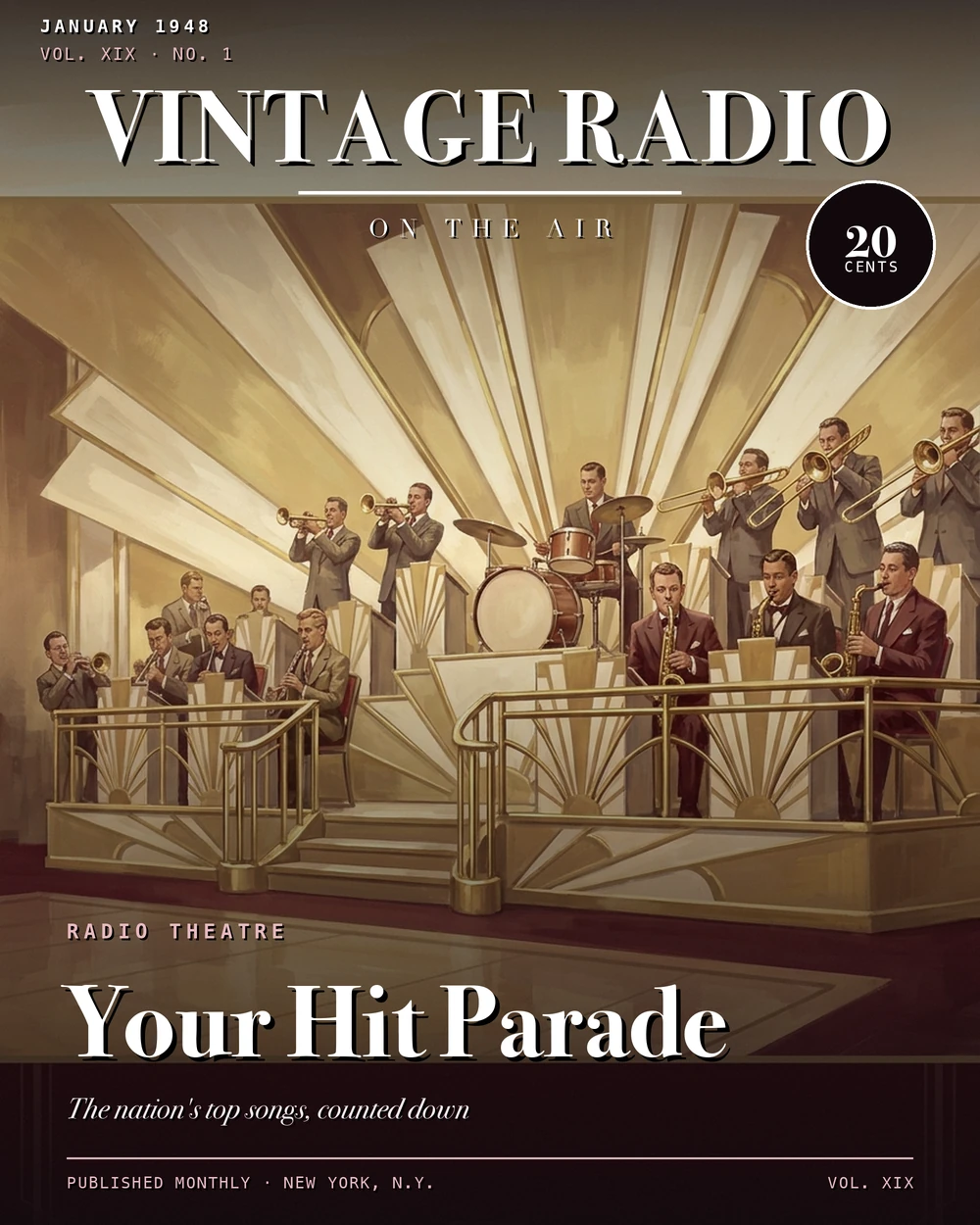
Your Hit Parade
The Idea Behind the Show
Before Billboard charts existed, before disc jockeys had a foothold on the airwaves, the question of what America was actually listening to had only one official answer: Your Hit Parade. The show premiered on NBC on April 20, 1935, a Saturday night at 8 PM, and from the start it was built around a single dramatic premise — that somewhere, a team of researchers was counting up the nation's most popular songs and would reveal the results live, on the air, with a trumpet fanfare and a drumroll announcing the top tune. The first number-one song on that inaugural broadcast was "Soon" by Bing Crosby, according to Bruce C. Byrd's Your Hit Parade & American Top Ten Hits.
What made that premise work was the secrecy around it. The show's tabulations were compiled in the offices of the advertising agency representing American Tobacco — originally Lord and Thomas, and later Batten, Barton, Durstine, and Osborne. The agency never fully disclosed its methods, releasing only a general statement that a "large staff" checked the statistics and that the system was "infallible." What was known: the data drew on radio requests, sheet music sales, dance-hall favorites, and jukebox tabulations. The final results came in by 8:30 PM on Saturday, but the actual order of the top songs wasn't known until Monday morning, which meant the orchestra and cast had just a few days to rehearse — about eight hours of preparation for each 45-minute broadcast. Radio Guide called the program "the most complex broadcast on the air." The tabulation data itself was reportedly transported to the advertising agency by armored truck.
Lucky Strike sponsored the entire run, and that gave the show a particular character from the start. American Tobacco president George Washington Hill ran the program with a firm grip, and the commercials he developed for it were unlike anything else on radio. Hill had spent time in North Carolina tobacco auction houses early in his career and became fascinated with the auction as a selling tool. He tracked down what he believed was the fastest tobacco auctioneer in the state — L. A. "Speed" Riggs of Goldsboro — and doubled his salary on the spot. He later added a second auctioneer, F. E. Boone of Lexington, Kentucky, whose flat monotone made a striking contrast to Riggs's singsong style, which always ended with "Sold to American!" Hill paid these two men $25,000 a year, according to his entry in Current Biography, to chant a combined one-and-a-half minutes of commercials per broadcast. The approach, which also deployed repetition ("Lucky Strike green has gone to war"), a clicking telegraph sound, and the slogan "LSMFT" ("Lucky Strike means fine tobacco"), came to be known as the "triphammer commercial."
The Lucky Strike Hit Parade on the Air
The show went through considerable structural changes across its nearly two decades on radio. The title itself wasn't settled at launch; the press used several names through 1935, and it didn't officially become Your Hit Parade until November 9, 1935. On March 11, 1936, the NBC broadcast was split into two: the existing Saturday show plus a new Wednesday-at-10 slot. Then in April 1936 the Saturday broadcast moved to CBS, where it would run until April 1947, while NBC continued its Wednesday run until December 1937.
The format also evolved over time. It originally presented the 15 top songs in random order; the familiar countdown structure — building suspense toward the top three — was established only after several years on the air. The number of songs per show varied between seven and fifteen, with seven being most common in later years.
The CBS era brought a long parade of vocalists through the show. Early CBS regulars included Buddy Clark, who was paired with Margaret McCrea, then Edith Dick, and eventually Fredda Gibson — later known as Georgia Gibbs — during the 1936–38 seasons. Bea Wain sang on CBS for two stints totaling three years between 1939 and 1944. Joan Edwards joined in late 1941 and stayed five years; she became popular enough that servicemen organized a nationwide "Moan-and-Groan-for-Joan" club in her honor. Frank Sinatra joined in 1943 and brought what could charitably be called an enthusiastic audience — a screaming crowd of bobby-soxers, as the press described them. When Sinatra left in early 1945, Lawrence Tibbett stepped in as a replacement, a radical change in register; the teenage screaming stopped, but the ratings reportedly jumped seven points. Andy Russell arrived in mid-1946 and his fans, promptly nicknamed "Russell's Sprouts," brought the screaming back.
The CBS orchestra during this period was led by Richard Himber, Leo Reisman, and Peter Van Steeden through 1939, then by Mark Warnow as permanent musical director from 1939 to 1947. Warnow died of heart failure at 49 in 1949; his brother, Raymond Scott — born Harry Warnow — stepped in as conductor and would lead the orchestra through the full television run. In 1938, W.C. Fields performed a comedy routine on a CBS broadcast, with Walter Tetley playing the brat who pestered him, one of the more unusual detours a music program ever took. Ethel Smith came aboard as the show's organist in 1942. Script continuity in the late 1930s and early 1940s was written by Alan Jay Lerner — before he became famous as a lyricist — who turned out more than 500 radio scripts between 1940 and 1942, including work for Your Hit Parade, before meeting composer Frederick Loewe at the Lambs Club in New York in 1942.
Announcer André Baruch worked the CBS run throughout, and there was an unusual personal connection built into the broadcast: Baruch's wife was Bea Wain, one of the show's regular vocalists. Radio Life noted in 1943 that it was not unusual to see devoted fans of certain songs become joyous, vindictive, or disappointed as the week's results came in. Bets were placed on the outcome. The countdown to the Number One Song, climaxed by that trumpet fanfare and drumroll, had become a genuine weekly ritual.
The NBC Return and the Road to Television
The show returned to NBC on April 26, 1947, where it remained until the radio run ended on January 16, 1953. Sinatra came back in September 1947 and brought with him his own orchestra leader, Axel Stordahl, who had been his colleague in the Tommy Dorsey days. Stordahl led the NBC orchestra through 1949. That same year, 1947, saw an extraordinary roster of vocalists pass through the show: Dinah Shore, Ginny Simms, the Andrews Sisters, Martha Tilton, Dick Haymes, and Doris Day all appeared. In the fall of 1951, the radio show moved to Thursday nights with Guy Lombardo and his Royal Canadians as the featured orchestra, with a rotating "Lucky Star of the Week" guest female vocalist each broadcast. Lombardo hosted through the final radio broadcast on January 16, 1953.
The show had already begun simulcasting on television by then. A trial TV run started on NBC on July 10, 1950, initially as a summer replacement for Robert Montgomery Presents. The radio and TV versions ran simultaneously on Saturday nights during the 1950–51 season — the radio program at 9:00–9:30 PM Eastern and the TV show at 10:30–11:00 PM.
The television production was a considerable operation. The show presented the top seven songs of the week in reverse order, plus "Lucky Strike Extras" — older popular songs familiar to audiences. Because a hit could dominate the list for weeks at a stretch — "White Christmas" appeared on the Your Hit Parade list 38 times over the years, returning reliably each winter — the production team had to keep finding new ways to present the same material. The 1953 Peabody Award the show received cited exactly this challenge, noting that "when a hit song must be used for as many as 16 consecutive weeks, unusual ingenuity is required to keep the program fresh and original," and praising "consistent good taste, technical perfection and unerring choice of performers."
The peak-years television cast was Dorothy Collins, Snooky Lanson, Russell Arms, and Gisèle MacKenzie — two of the four Canadian-born. Collins, born Marjorie Chandler in Windsor, Ontario, had met Raymond Scott when she was 14 years old in Chicago in 1940 and became his protégée; by 15 she was a featured vocalist with his orchestra. Scott was commissioned by Lucky Strike to write commercial jingles and had Collins sing them; the sponsor signed her to the show when the official TV run launched in October 1950. On air she became known as "America's girl-next-door." Scott and Collins married in 1952. The opening commercial jingle, "Be Happy Go Lucky," sung by the Hit Paraders each week, was composed by Scott, who also pioneered the television use of prerecorded accompaniment with live vocal performances on the program. Scott's work during this period extended well beyond the show itself: he built two of the world's first multi-track tape recorders — 7 and 14 tracks — in 1952, and in 1956 was granted a US Patent for the Clavivox, a keyboard theremin that evolved into one of the first synthesizers.
Snooky Lanson, born Roy Landman in Memphis in 1914, had started his professional career singing on WSM radio in Nashville in 1934. He once recalled singing "Mona Lisa" for 13 straight weeks because it was identified as a man's song and he was initially the only male vocalist on the program. Russell Arms eventually joined him, and both appeared alongside Collins and Gisèle MacKenzie through the show's peak years. MacKenzie joined the TV cast in 1953 and during her tenure had her own chart hit, "Hard to Get," which reached #5 in June 1955. Raymond Scott's choral director for the TV run was Ray Charles — not the singer, but the vocal arranger who had worked on the show's pilot telecasts in 1949, though he didn't receive on-screen billing until 1955 because he was simultaneously directing a choir on a program sponsored by competing cigarette brand Chesterfield. The TV production drew other notable behind-the-scenes talent: director Norman Jewison and Clark Jones (nominated for an Emmy in 1955) worked on the show, choreographer Tony Charmoli won an Emmy in 1956, and Bob Fosse appeared as a guest dancer during the 1950–51 season.
Why It Stopped Working
The show's ratings on television were solid through the mid-1950s — #15 for the 1954–55 season — and then rock and roll arrived. The format that had worked for two decades depended on the show's vocalists being able to perform any song that landed on the weekly list, in the show's established style. Snooky Lanson's weekly attempts to perform Elvis Presley's "Hound Dog" in 1956 became the most-cited example of the mismatch. Author Arnold Shaw, quoted in Let's Dance, described the awkwardness of the performers trying to handle rock material in a production framework built for a different era.
In the fall of 1957, the television show was moved to Hollywood, revamped with a new cast — Tommy Leonetti, Jill Corey, Alan Copeland, and Virginia Gibson — broadcast in color, and became the first television show to be introduced by the animated "Living Color" peacock that is now the NBC logo. None of it helped. The show moved to CBS on October 10, 1958, with Dorothy Collins and Johnny Desmond, and ratings fell to #60 for that final season. The television run ended on April 24, 1959. American Tobacco had redirected its advertising budget elsewhere, and the show's inability to adapt to rock and roll had made the decision easy.
Lucky Strike had also spun off two related programs during the radio years. Your All-Time Hit Parade ran on NBC from February 1943 through September 1944, devoted to standards and all-time favorites mixed with current hits. A second spin-off, a daytime talent competition called Your Lucky Strike hosted by Don Ameche, ran on CBS in 1948 with housewives as judges, voting by long-distance phone call for little-known professional vocalists who competed for bookings at clubs including the Mocambo and Earl Carroll's.
CBS revived Your Hit Parade for brief summer runs in 1974 and 1975. The 1974 version, packaged by Chuck Barris, featured Kelly Garrett, Sheralee, and Chuck Woolery, with Milton DeLugg conducting. It mixed hits from designated past weeks in the 1940s and '50s with current popular songs performed by original artists. Neither revival found an audience.
The show's most lasting contribution may be structural. It predated Billboard magazine's inaugural music popularity chart by nearly a year — Billboard's first chart appeared in January 1936 — and its proprietary methodology, however secretive, helped establish the concept of a ranked weekly popular music list. According to Arnold Shaw's account in Let's Dance, the program itself helped establish radio as the dominant venue for American popular music. The elaborate production concepts it developed for television — the skits, sets, and costumed presentations built around individual songs — are cited as an influence on the music video format that followed in subsequent decades.